
The mistake the enemies of the deal in India and the US are making is to seek satisfaction over their own wish list.
The government Wednesday asserted that no inspections by the Internatioal Atomic Energy Agency are being carried out in any of the R&D institutions in India.

India will next Monday sign a key safeguards agreement with the International Atomic Energy Agency to allow supply of atomic fuel and technology to the country moving a step closer to operationalising its international civil nuclear cooperation after the 34-year-old nuke trade embargo was lifted.
The International Atomic Energy Agency said it was close to finalising the text of India-specific safeguards but the ball is now in India's court to ready the agreement. Sources at IAEA said both sides are close to a final text but India has to confirm to the IAEA that there is an agreement on the text. Until then the agreement can not got forward.
The Left parties on Wednesday night said that the government's move to get the draft nuclear safeguards agreement circulated to the International Atomic Energy Agency's Board of Governors was 'expected', especially after Prime Minister Manmohan Singh's remarks that the nuclear watchdog will be approached very soon.The Bharatiya Janata Party expressed surprise about how the draft was circulated.
An additional protocol to the nuclear safeguards agreement between the International Atomic Energy Agency and the US, giving the agency better access to nuclear sites has entered into force, making America the last of the five atomic-weapon states party to the global non-proliferation pact.
The four-day talks that concluded on Saturday were originally considered to be a final round but the draft text could not be completed, IAEA sources said, adding that there was also no meeting point on the issue of corrective measures to be undertaken in the event of stoppage of fuel to power plants.
International experts reaching Vienna for the 51st general conference of the IAEA are understood to be keen to know about the opportunities likely to emerge if the Indo-US civil nuclear deal goes through.
DAE officials, who had marathon discussions for the last two days in Mumbai on the issue of safeguards to be discussed with the IAEA, received confirmation of an appointment with ElBaradei on Sunday night to initiate negotiations, the DAE sources said.
Even before it faces the confidence vote in the Lok Sabha, the government will brief the International Atomic Energy Agency board of governors in Vienna on July 18 on the India-specific safeguards agreement, which the board is likely to discuss on August 1 to help the implementation of the Indo-US nuclear deal. India on Monday informed the 35 member-countries on the board of governors about the July 18 briefing, IAEA sources said.
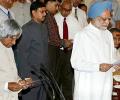
The landmark India-US civil nuclear deal of 2008, brokered during Manmohan Singh's tenure as Prime Minister, is seen as a crowning achievement in his foreign policy legacy. The agreement ended India's nuclear isolation, fostered a strategic partnership with the US, and opened doors to advanced technologies and defense cooperation. This historic deal also laid the groundwork for India's engagement with the global nuclear community.
At a press briefing at Washington DC's National Press Club on the eve of the IAEA board of governors meeting, nonproliferation experts called on the NSG not to reach a consensus on the accord, since it was 'seriously flawed and would undermine the professed objectives of the NSG'
India will begin another round of talks with the global nuclear watchdog International Atomic Energy Agency in Vienna from Monday for negotiating the safeguards agreement, a pre-requisite for the India-United States nuclear agreement. The Indian delegation, led by R B Grover, a top official in the Department of Atomic Energy, reached Vienna today for the talks, which are expected to go on till the month-end.

The Pakistan Foreign Office issued a statement in response to questions from the press about reports in the media on the 'seizure of possible radioactive material' by Indian authorities at Mundra Port on a cargo ship from Karachi Port to Shanghai in China.
Communist Party of India General Secretary A B Bardhan warned that if government officials held talks with visiting International Atomic Energy Agency chief Mohamed El-Baradei about the nuclear agreement, the Left Front would withdraw its support to the government. "Let the IAEA chief meet Dr Manmohan Singh and other political dignitaries. But if the govt officials hold talks with El-Baradei about the safeguards of the 123 agreement, we will pull the rug," he threatened.

China continues to sell nuclear reactors to Pakistan, a US think-tank has said, expressing concern over export of nuclear materials in violation of international norms and established procedures.

"A Biden administration will be mostly positive for India," said Rick Rossow from the Centre for Strategic and International Studies think tank. "I expect most positive areas of cooperation -- notably defence -- to be maintained," he said.
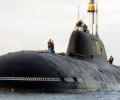
China on Tuesday angrily denounced the nuclear-powered submarine deal announced by the US, UK and Australia, saying the pact violates the Non-Proliferation Treaty (NPT) and the three countries are travelling "further down the dangerous and wrong path."
Lobbying for the Indo-US nuclear deal, India on Friday briefed the International Atomic Energy Agency Board of Governors and some Nuclear Suppliers Group countries on the safeguards agreement amid reports that there was no sign of opposition to the accord.

India, along with the United States and Pakistan, has voted against a provision in a United nations resolution calling on to 'promptly' accede to the Non-Proliferation Treaty as non-nuclear-weapon nation 'without conditions' and to place all its nuclear facilities under International Atomic Energy Agency safeguards.
Stepping up the ante, Prime Minister Manmohan Singh has declared that India will approach the IAEA on the Indo-US nuclear deal very soon and the process will move very fast. Talking tough, he said he would discuss the nuke deal with US President George W Bush and other leaders and seek their support. He also said he was ready to face Parliament for a trial of strength.
A senior minister said Friday's meet UPA-Left committee on the Indo-US nuclear deal was crucial to allow the government to approach the IAEA.
It is paradoxical that even those members who are most crucial in the decision-making process, leave alone the public, are denied access to scrutinise the full text of the IAEA agreement while many in the international community, particularly those from the NSG countries, must be scanning it with a microscope!
The United Progressive Alliance-Left stand-off on Indo-US nuclear deal notwithstanding, the Indian Atomic Energy department is holding consultations with International Atomic Energy Agency for working out a safeguards agreement.
In a major breakthrough in the nuclear deal standoff, the Left parties on Friday relented and gave clearance to the government to approach the International Atomic Energy Agency for working out an India-specific safeguards agreement.
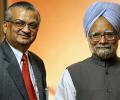
'Dr Singh, visibly relieved, said, 'Yesterday night I couldn't sleep. I stayed awake, praying throughout. You have saved the country'.' A fascinating excerpt from former atomic energy chief Dr Anil Kakodkar's memoir Fire And Fury: Transforming India's Strategic Identity.
Indian negotiators and International Atomic Energy Agency officials will meet shortly in Vienna to iron out the differences in readying the 'agreed text' on India-specific safeguards, which is crucial to operationalise the India-United States nuclear deal.
Agreements may provide rights but this does not mean asserting them or implementing them will be easy. India may consider itself to be on firm legal ground in invoking Paragraph 29, for example, in order to deal with the consequences of a fuel supply disruption, but the political opposition it will encounter internationally could be formidable. Some of this political opposition could even be couched in legal terms.
India has received a positive response from the Non-Aligned Movement countries, which are members of the International Atomic Energy Agency and the Nuclear Suppliers Group on the Indo-US nuclear deal after it briefed them on the safeguards agreement, which the global nuclear watchdog will consider on Friday.
Not satisfied with the UPA's replies to their queries on the nuclear issue, the Left parties are likely to ask the government to finalise an India-specific safeguards agreement with International Atomic Energy Agency only after the 123 agreement with the US lapses.
Uncertainty over the Indo-US nuclear deal cast a shadow over the first Indo-French nuclear business meet in Mumbai, which was aimed at strengthening bilateral cooperation in the atomic field.
Notwithstanding the Left parties' threat to the government not to carry forward the safeguards talks with IAEA beyond December, India opened the second round of discussions with the nuclear watchdog.

Dr Kakodkar's strategic stubbornness ultimately got India what it wanted though the negotiations with the US went to the wire, notes Shivanand Kanavi.
The Left-UPA committee, that has been constituted to look into the apprehensions voiced by the Left Front, is likely to meet on November 18. In the meeting, the Left Front may clear the government's move to approach the international atomic watchdog but without committing anything in writing, Left sources said. Prime Minister Manmohan Singh, during a luncheon meeting with Prakash Karat and A B Bardhan last week, had sought their nod for the government to approach the IAEA.
Racing against time, the government made the attempt during a meeting between Prime Minister Manmohan Singh and top Left leaders Prakash Karat and A B Bardhan in the presence of United Progressive Alliance Chairperson Sonia Gandhi and External Affairs Minister Pranab Mukherjee.
A new draft proposal circulated among Nuclear Suppliers Group member states early this month could pave the way for India to become a member of the elite club, but this is unlikely to happen before the end of the Barack Obama presidency next month.
India has cancelled its briefing on the safeguards agreement for the members of the International Atomic Energy Agency, which was scheduled to be held in Vienna on July 18.The IAEA safeguards agreement is an essential step India has to take to integrate with international nuclear commerce before it secures a one-time waiver from the 45-nation Nuclear Suppliers Group.
